
Written by Delia Brows Studio
 Professional beautician specialized in rejuvenation, facial diagnosis, aesthetic equipment and advanced skin care. Recommendations, guides and products with backup dermatological and visible results. Also certified in micropigmentation and therapeutic massage, integrating well-being, advanced equipment and comprehensive aesthetics.
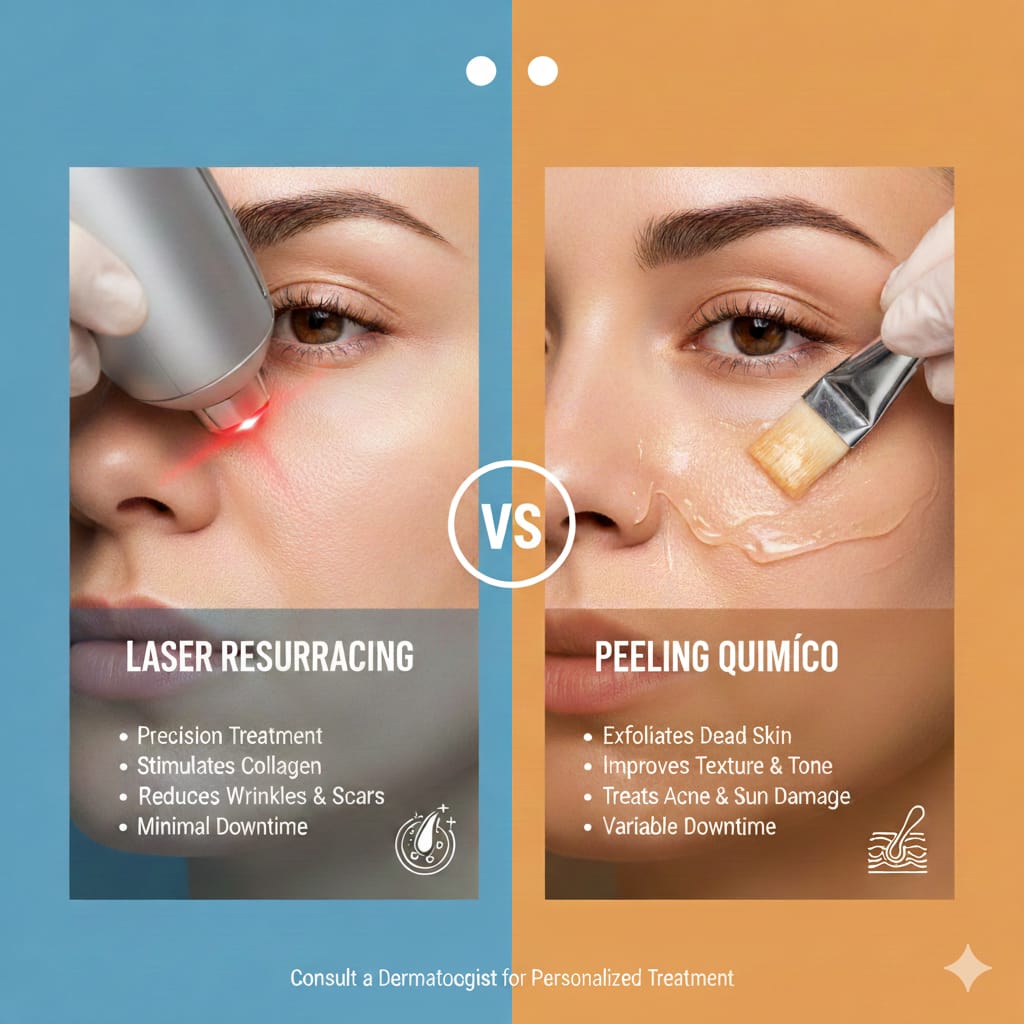
The search for radiant skin, free of imperfections and with a youthful appearance has led to the development of a variety of high-effective aesthetic treatments. Among the most requested and tested are chemical peelings and laser treatments. Both methods are powerful skin renewal tools, but they operate in a fundamentally different way and are therefore indicated for different dermatological concerns and skin types.
Choosing between a laser and a chemical peel is not a question of which is «better» in absolute terms, but of which is the most suitable for the specific objectives of your skin, your type of life and your tolerance to downtime.
This article, verified and based on the consensus of dermatological practice and clinical evidence, breaks down the characteristics, mechanisms of action, indications and expected results of each treatment so that you and your medical professional can make the most informed decision
Chemical Peeling: Controlled Exfoliation Renewal
Chemical peeling is a procedure in which a controlled acid solution is applied to the skin to induce an accelerated and controlled exfoliation of the damaged or superficial layers of the epidermis, and in some cases, of the upper dermis. The depth of the exfoliation determines the intensity of the result and the recovery time.
1. action mechanism
The acid solution (composed of ingredients such as glycolic acid, salicylic acid, trichloroacetic acid or phenol) breaks down the bonds that hold dead and damaged cells together. By removing the surface layer, cell regeneration and the production of collagen and elastin are stimulated in the deeper layers.
2. Classification and depth
* Superficial: affect only the outermost layer (stratum corneum).
* Indications: Mild acne, rough texture, luminosity, superficial hyperpigmentation.
* Idle time: Minimum (mild redness, subtle desquamation for 1-3 days).
* Media (ex. Trichloroacetic acid – TCA 20-35%): penetrate to the papillary dermis.
* Indications: moderate photodamage, fine wrinkles, superficial scars, keratosis, moderate hyperpigmentation (melasma).
* Downtime: Moderate (obvious decay and scabs for 5-7 days).
* Deep (eg. phenol, TCA > 50%): Reach the reticular dermis.
* Indications: Deep wrinkles, severe scars, severe photodamage.
* Idle time: prolonged (can be 2 weeks or more). Requires sedation and cardiac monitoring (in the case of phenol).
3. Proven Advantages
* Cost-effectiveness: They are generally less expensive than laser treatments.
* Uniformity: Provide uniform exfoliation in large areas.
* Safety on dark skin: Careful and middle peelings are carefully selected and applied by experts (eg, modified Jessner solution) can be safer in high phototypes (dark skin) than certain types of lasers, provided that rigorous pre- and post-treatment protocols are followed to prevent post-inflammatory hyperpigmentation (HPI).
Laser treatments: precision and focused energy
Laser treatments use highly focused light beams to target specific chromophores (such as water, melanin, or hemoglobin) inside the skin. The light energy is converted into heat, causing a controlled thermal injury that stimulates healing and neocologenesis.
1. Mechanism-based classification
1.1 Ablative lasers:
* Mechanism: They vaporize the outer layers of the skin (epidermis and part of the dermis). Simulate a controlled wound that heals with new, regenerated skin, stimulating collagen contraction.
* Indications: Deep wrinkles, severe acne scars, skin laxity, advanced photodamage.
* Downtime: significant (1 to 3 weeks of redness and scaling).
1.2 Non-ablative lasers:
* Mechanism: They heat the inner layers (dermis) without significantly damaging the surface (epidermis). This stimulates the production of collagen from within.
* Indications: Fine wrinkles, light pigmentation, pores dilated, redness.
* Idle time: minimum or no (some of redness per hour).
* Vascular/pigmentary lasers (eg. Intense pulsed light – IPL, Q-Switched):
* Mechanism: They selectively target melanin (pigment) or hemoglobin (vessels).
* Indications: Sun spots (lentigo), melasma (certain types of laser), telangiectasias (broken blood vessels), rosacea.
* Idle time: Minimum (possible temporary darkening of the spots).
2. Proven Advantages
* Precision and depth: allow for exact control over the depth and treatment area, which is essential for deep scars and localized wrinkles.
* Efficacy in tensioning: Ablative and fractional lasers are superior to achieve significant skin tensioning, since the heat causes an immediate contraction of collagen.
* Vessel treatment: Only the laser can effectively treat vascular lesions and redness associated with rosacea.
laser vs. Peeling: A Comparative Evidence Based Analysis
The table below summarizes the strengths of each treatment for specific skin concerns, based on the dermatological literature.
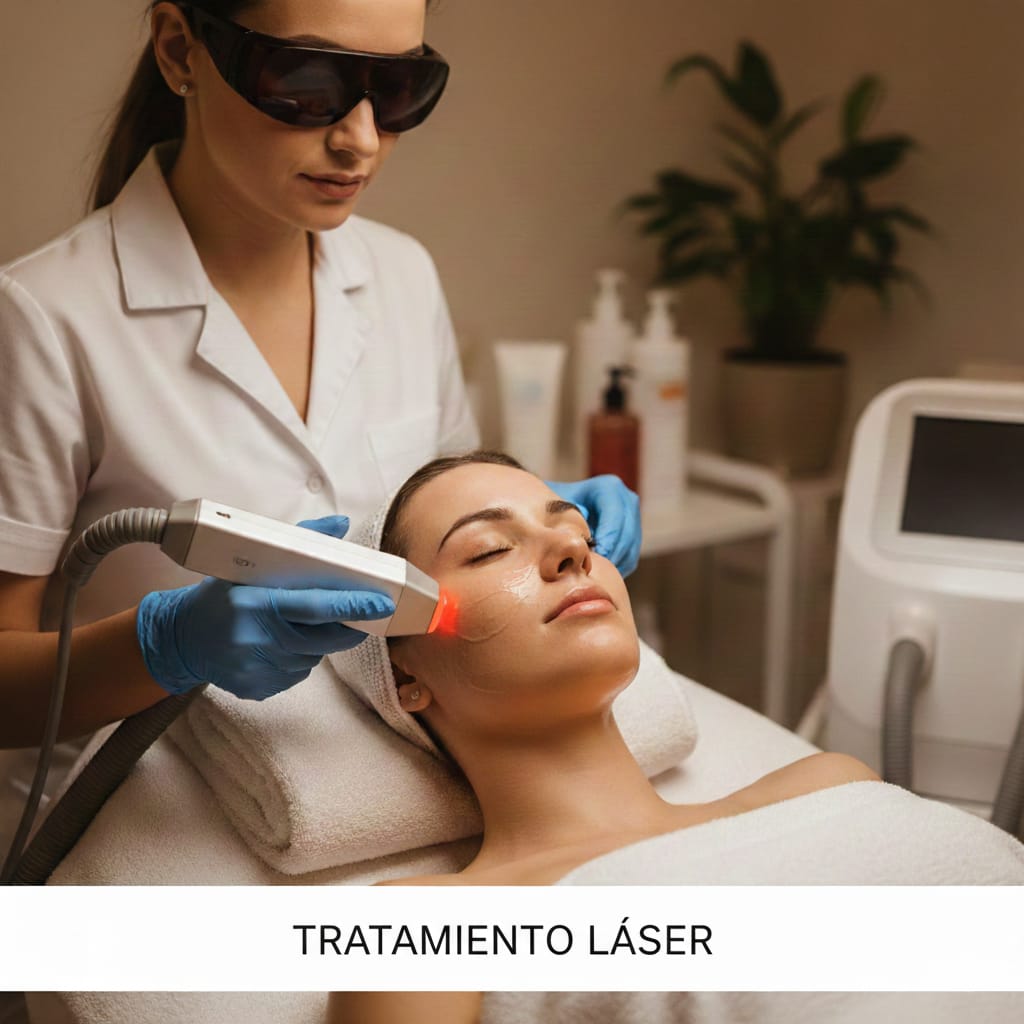
The critical factor: skin type (phototype)
The golden rule in aesthetic dermatology is as follows: The darker the skin (Fitzpatrick phototypes IV to VI), the greater the risk of post-inflammatory hyperpigmentation (HPI) after any procedure that causes inflammation or heat.
*Dark Skin Chemical Peeling: It is the safest option for most high phototypes, especially if mild peelings (such as Mandelic acid or Jessner) are used and is combined with a strict skin preparation protocol (hydroquinone pre-treatment or tyrosinase inhibitors).
* Dark skin laser: ablative lasers are extremely risky. Non-ablative lasers should be used with great caution. Picosecond lasers and certain ND:YAG (safer) are often the choice to treat pigmentation, but the cooling protocol and operator experience are crucial.
Clinical Conclusion: For dark skin with superficial concerns, chemical peeling usually offers a better risk-benefit ratio. For deep concerns, a highly experienced specialist and specific laser technology are required.
The impact of downtime and lifestyle
The decision is not only based on efficacy, but also what the patient can tolerate:
* Fast recovery (peeling): If the patient cannot afford to take days off, a cycle of superficial or non-ablative peelings is the best option. The result will be gradual.
* Long recovery (laser or deep peeling): If you are looking for a dramatic change in a single session and the patient can hide for 1-2 weeks, the ablative laser or a medium to deep TCA peeling will offer the maximum correction.
Expert Conclusion: It is not a competition, but a synergy
In modern clinical practice, the trend is not to choose the laser against chemical peeling, but to use them synergistically.
* Preparation Peelings: A dermatologist can use a surface chemical peeling to refine the texture, reduce sebum, or treat melasma before laser treatment, optimizing the canvas so that the laser penetrates more evenly and deeply.
* Laser for structural correction: The laser is reserved for structural correction of wrinkles, scars and dermal laxity that cannot be achieved by acids.
the verdict:
* If your target is the maximum correction of wrinkles and deep scars in a single session, the evidence points to the ablative laser (CO2).
* If your goal is to improve texture, uniform tone and treat surface pigmentation with a low risk of HPI (especially in dark skin), chemical peeling (middle or shallow) is superior.
* If your concern is blood vessels or rosacea, only the vascular laser/IPL is the treatment of choice.
Ultimately, the best treatment is the one that is custom designed by a professional certificate. Only a dermatologist or plastic surgeon with experience in both modalities can correctly diagnose the depth of your skin damage and select the safest and most effective method for your goals.

Digital Course: Chemical Peeling Protocol
Related Articles
Professional Post-Peeling Routine: What to Do and What Not to Do to Avoid Stains
Professional beautician specialized in rejuvenation, facial diagnosis, aesthetic equipment and advanced skin care. Recommendations, guides and products with dermatological support and visible results. Also certified in micropigmentation and massage...

Protocol for combination skins «a perfect balance»
By caring for your skin, you not only enhance your outer beauty, but also nourish your inner well-being. Enjoy self-care and watch your skin bloom over time. Your skin deserves the best! For better care, we offer you this skin protocol...
No Results Found
The page you requested could not be found. Try refining your search, or use the navigation above to locate the post.
Become a certified expert in smart microneedling
Access to my premium course
Learn to master the most advanced facial rejuvenation technique adapted to Latin skins.
subscribe to my list
I only commit to sending you a quality email monthly
Follow us
Follow me on all my social networks